24 November, 2026
A seven-year-old who freezes at a page of sums is rarely “bad at maths.” More often, they have learned to expect being wrong, and that fear blocks the thinking they are perfectly capable of. Maths anxiety is real; it starts earlier than most parents expect, and the right classroom habits can ease it before it hardens into “I hate maths.”
That is why parents shortlisting a top school in Gurgaon are increasingly asking how teachers handle a child who panics over numbers. This guide explains what maths anxiety looks like, why it begins so young, and what schools and parents can do about it.
Maths anxiety is a feeling of tension or fear when facing numbers or maths problems. In young children, it rarely sounds like “I’m anxious.” It shows up as behaviour:
Research from the University of Chicago found that children as young as first grade report high anxiety about maths, and that this anxiety is linked to their maths achievement. Early support matters because the feeling can grow with each difficult experience.
The link between anxiety and performance is consistent worldwide. In PISA 2022, the OECD found a negative association between maths performance and maths anxiety in every education system that took part, without exceptions.
The problem also appears to be growing. Across OECD countries, the share of 15-year-olds who said they get very nervous doing maths problems rose from 31% in 2012 to 39% in 2022. These are teenagers, but anxiety at that age often has roots in early classroom experiences.
Maths anxiety rarely develops overnight. It often stems from everyday experiences, adult attitudes, and early learning environments that gradually shape how children perceive numbers and their own abilities.
Children pick up on adults’ feelings about maths. In a University of Chicago study, children of maths-anxious parents learned less maths over the school year and were more likely to become maths-anxious themselves, but only when those parents helped frequently with maths homework.
Lead researcher Sian Beilock noted that even comforting phrases like “I’m not a number person” can send the message that you either are a maths person or you are not.
Beilock has also pointed out that maths is often one of children’s first experiences of being told they are right or wrong. Timed tests, red marks and public answers can make that feel high-stakes very quickly.
When children jump to written sums before they understand quantity, maths becomes rules to memorise rather than ideas that make sense. Confusion can easily turn into fear.
Teacher support makes a measurable difference. PISA 2022 results show that in 64 countries and economies, students who receive more support from teachers tend to experience lower levels of maths anxiety. In practice, good schools in Gurgaon and elsewhere tend to use approaches like these:
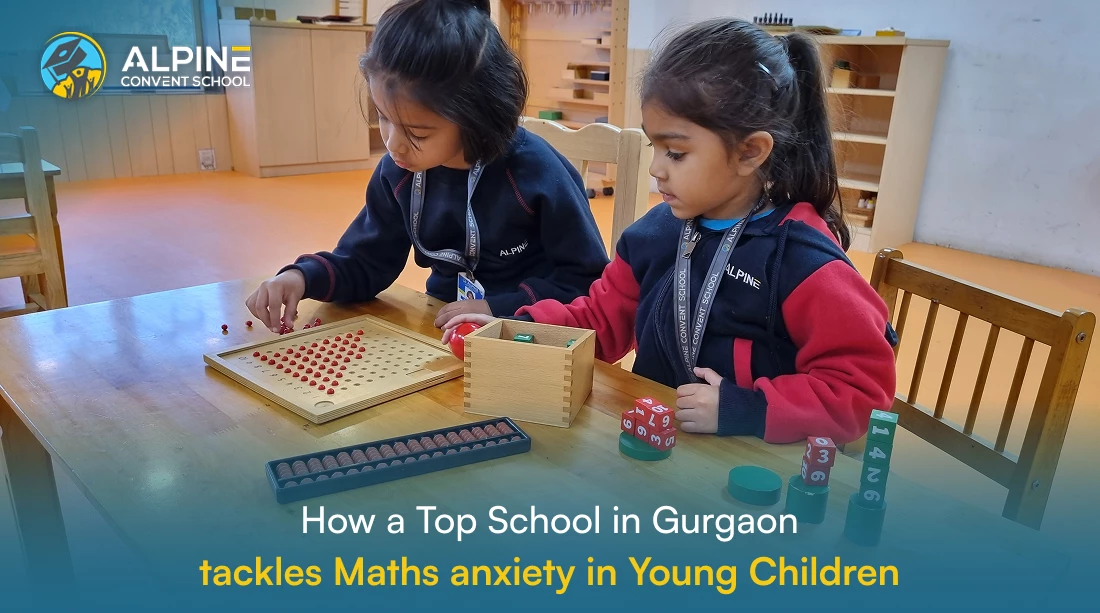
1. Start with hands-on materials: Counting beads, blocks, number rods, and real objects help children see and touch quantities before writing them. Understanding comes first, then symbols.
2. Treat mistakes as part of learning; Teachers who ask “How did you get that?” instead of only marking answers wrong help children see errors as clues, not failures.
3. Reduce time pressure in the early years: Speed drills can wait. Young children benefit from time to think, explain, and try again.
4. Connect maths to daily life: Measuring ingredients, counting money, telling time and sharing snacks show children that maths is useful and familiar, not just a worksheet.
5. Offer extra support early: When a child struggles, small-group help or one-to-one attention can stop a gap from becoming a fear.
At Alpine Convent School, the Montessori programme for ages 2 to 6 includes mathematics as one of five learning areas, alongside real life, sensory, language and cultural studies. The school’s website also describes an emphasis on experiential learning, where students gather knowledge, apply it and find new resources, and lists learning support among its pastoral care areas.
If maths confidence is a concern for your child, ask the school during a visit how these approaches show up in daily maths lessons and how teachers support a child who feels anxious.
Schools and families work best together. A few simple habits help:
Maths anxiety is common, but it is not permanent. With hands-on learning, patient teachers and calm support at home, most children can rebuild their confidence.
The best way to judge a school’s approach is to see it in action. You can schedule a campus visit at Alpine Convent School, explore its Montessori programme, or apply online. For admission queries, call +91 9999 700 821 or email enquiry@alpineconventschool.com. Campuses are in Sector 10, Sector 38, Sector 56, Sector 67 and Sushant Lok-1 (Sector 28), Gurugram.
Yes. Persistent maths anxiety can affect concentration, working memory and confidence, particularly during problem-solving activities. Children may also become hesitant to participate in classroom discussions or attempt unfamiliar tasks. Building emotional confidence around learning can therefore support their overall academic development.
Maths anxiety and dyscalculia can have overlapping signs, but they are different. Anxiety involves fear or stress around mathematical tasks, while dyscalculia affects the ability to understand and process numbers. Teachers can observe learning patterns and recommend a professional assessment when difficulties persist.
Repeated practice does not automatically build confidence. If children associate practice with pressure, criticism, or repeated failure, their anxiety may increase. Short, enjoyable activities with achievable challenges are more effective. Children should feel comfortable asking questions, making mistakes, and learning at their own pace.
Confidence influences whether children attempt unfamiliar problems, explore different solutions, and persist when answers are not immediately clear. A child who fears making mistakes may avoid challenging activities altogether. Encouraging curiosity and independent problem-solving helps children develop both mathematical understanding and confidence.
Yes, particularly when anxiety causes frequent distress, affects school attendance, or extends to other learning activities. Parents can first discuss their concerns with the class teacher and school counsellor. A child psychologist or qualified educational specialist can help identify underlying difficulties and suggest appropriate interventions.


16 November, 2026


17 October, 2026
16 October, 2026