17 November, 2026
Your toddler does not need flashcards, rhymes on demand, or a rehearsed introduction to get into nursery. What helps most is a child who feels comfortable in a new room, can manage a few minutes away from you, and is curious enough to pick up a toy and play. Preparation is about building that comfort, step by step, in the months before admission.
If you are applying to the best play schools in Gurgaon for the 2027-28 session, now is the right time to start. This guide covers what schools usually look for, how to prepare your child at home, what to expect on interaction day, and how to make the first weeks easier.
Age decides which class your child can apply for. In Haryana, the rules have tightened. From the 2026-27 academic year, the state is strictly enforcing a minimum age of six for Class 1 and has ended the earlier six-month relaxation. Pre-primary ages are counted backwards from that.
Delhi follows a similar pattern. Under the DoE’s rules, the minimum ages as on 31 March are 3 for Nursery, 4 for Lower KG, 5 for Upper KG and 6 for Class 1.
Class names also vary. At Alpine Convent School, pre-primary runs as Pre-Montessori and Montessori levels. The school lists Pre-Montessori for children aged 2+ and Montessori-1 for children aged 3+ as of 31 March of the admission year, with possible age relaxation of a few months depending on the child’s development. Always confirm the exact birth-date window with each school.
Most play schools in Gurgaon do not test toddlers. The interaction is usually an informal meeting to understand the child and the family. In general, schools observe things like:
These are not pass-or-fail checks. A shy or quiet child is completely normal at this age.
The CDC’s developmental milestones offer a useful reference. At age 3, one milestone is calming down within 10 minutes after a parent leaves, such as at a childcare drop-off. Another is noticing other children and joining them to play. If your child is not there yet, that is fine. These are skills you can gently build.
Start two to three months before the interaction if you can. Toddlers learn through repetition, so small, steady steps practised every day work far better than a rushed week of preparation. The aim is not to teach new skills overnight but to make school-like situations feel familiar.
Begin by leaving your child with a grandparent or trusted adult for about 30 minutes, then stretch it gradually to an hour or two over a few weeks. Always say a clear, cheerful goodbye and tell them when you will be back, such as “after your snack.” Sneaking away may avoid tears in the moment, but it can make children more anxious about the next separation. For reference, the CDC lists calming down within 10 minutes after a parent leaves as a typical milestone by age 3, so a few tears that settle quickly are completely normal.
Regular time around other children helps toddlers get used to sharing space, toys and adult attention. Visit parks at busy hours, join toddler music or movement sessions, or arrange small play dates with one or two children of a similar age. Start with short, low-pressure meetups and stay nearby at first.
Over time, step back a little so your child learns to play without checking on you constantly. Children who have practised taking turns and joining group games usually find the first weeks of a classroom less overwhelming.
Small tasks build confidence that carries straight into the classroom. Let your child wash their hands, open their own tiffin box, put on simple slip-on shoes and return toys to a basket after play. Resist the urge to step in too quickly, and allow a little extra time for mistakes. Teachers often notice which children can manage basic self-help, and those children tend to feel more settled because they rely less on adults for every need.
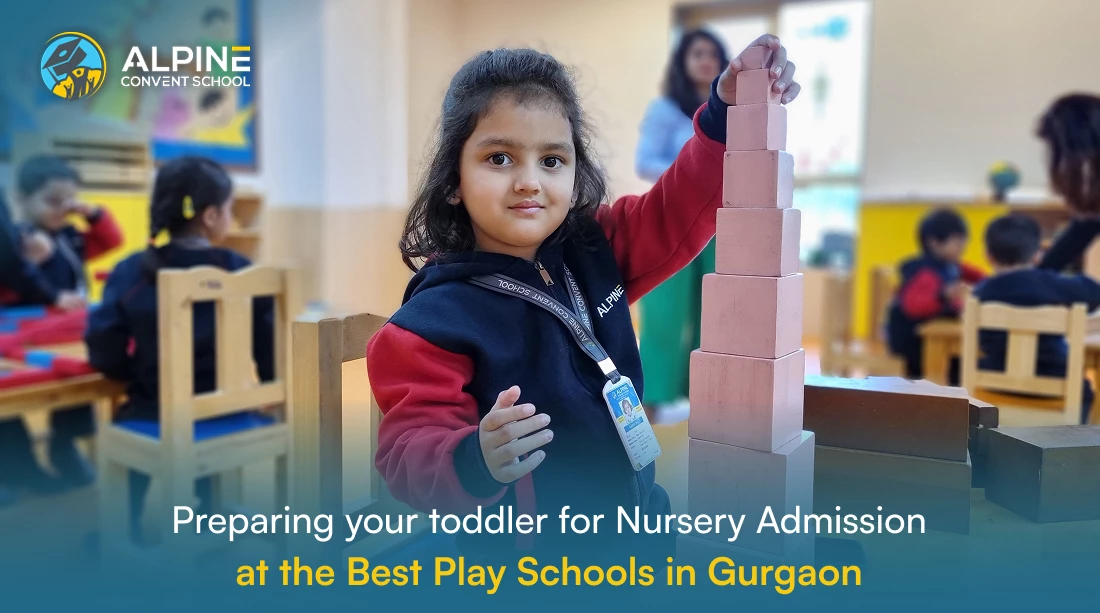
At Alpine Convent School, for instance, the Montessori programme for ages 2 to 6 builds this in. Its Practical Life activities are designed to develop independence, concentration and fine motor skills, with children practising basic movements such as pouring, folding and carrying.
Language grows fastest through real conversation. Name objects during daily routines, describe what you are doing while cooking or shopping, and read picture books together for 10 to 15 minutes each day. Ask simple questions like “Where is the dog?” or “What happens next?” and wait for your child to respond. Research from MIT found that the number of back-and-forth conversational turns between children and adults was strongly linked to children’s language scores. Chatting with your child matters more than drilling words or flashcards.
Most nursery sessions start in the morning, so a predictable daily rhythm makes the shift much easier. Fix wake-up, breakfast, play, meal and nap times close to what school hours will require, and keep them consistent on weekends too. Practise a short morning routine of washing up, dressing and eating breakfast at the same time each day. Bedtime matters just as much, because a well-rested toddler copes far better with new places and new faces. By the time the session begins, the school day will feel like a natural part of their routine.
A little planning reduces stress for both of you:
Remember that the interaction is also your chance to evaluate the school. Watch how teachers speak to children and how the classroom feels.
Processes differ between schools, but Alpine’s published process is a useful example. Parents register online or at the front desk, visit the campus, attend an interaction, and then complete admission by submitting the form with a seat-blocking fee, with documents due within 7 days of the offer.
Common documents include:
Keep scanned copies on your phone so you can apply to several schools quickly.
Lists of the best preschools in Gurgaon are easy to find online, but the right choice depends on your child. When visiting, ask:
The best play school in Gurgaon for your family is one where your child feels safe and curious, within a commute that suits a toddler.
Preparing your toddler for nursery is about comfort, routine, and gentle practice, not academics. A few months of small steps can make admission day and the first weeks far easier for your child.
If you are exploring options for 2027-28, see the environment for yourself. You can schedule a campus visit at Alpine Convent School, explore its Montessori programme, or apply online. For admission queries, call +91 9999 700 821 or email enquiry@alpineconventschool.com. Campuses are in Sector 10, Sector 38, Sector 56, Sector 67 and Sushant Lok-1 (Sector 28), Gurugram.
Most toddlers need a few days to several weeks to become comfortable in a new classroom. Adjustment depends on temperament, previous group experiences, separation comfort, and teacher support. A gradual settling-in routine helps children build trust and feel secure.
Limited speech does not automatically prevent a child from settling into nursery. Toddlers can communicate through gestures, expressions, and simple words. Parents should share their child's communication patterns with teachers so they can provide appropriate support and encourage language development through everyday interactions.
The teacher-to-child ratio affects how much individual attention each toddler receives. Smaller groups can make it easier for teachers to notice emotional needs, support communication, and guide daily activities. Parents should ask how many adults supervise each classroom throughout the school day.
A toddler's first week should focus on building familiarity rather than completing academic activities. Short classroom sessions, predictable routines, familiar play materials, and reassuring teacher interactions can ease the transition. Schools should communicate regularly with parents about the child's comfort and adjustment.
Children without previous group-care experience can still adjust successfully to nursery. Parents can introduce short play sessions, visits to child-friendly spaces, and supervised activities with other children. Gradually reducing parental involvement helps toddlers become comfortable exploring unfamiliar environments independently.
24 November, 2026

16 November, 2026

17 October, 2026
16 October, 2026