15 September, 2026
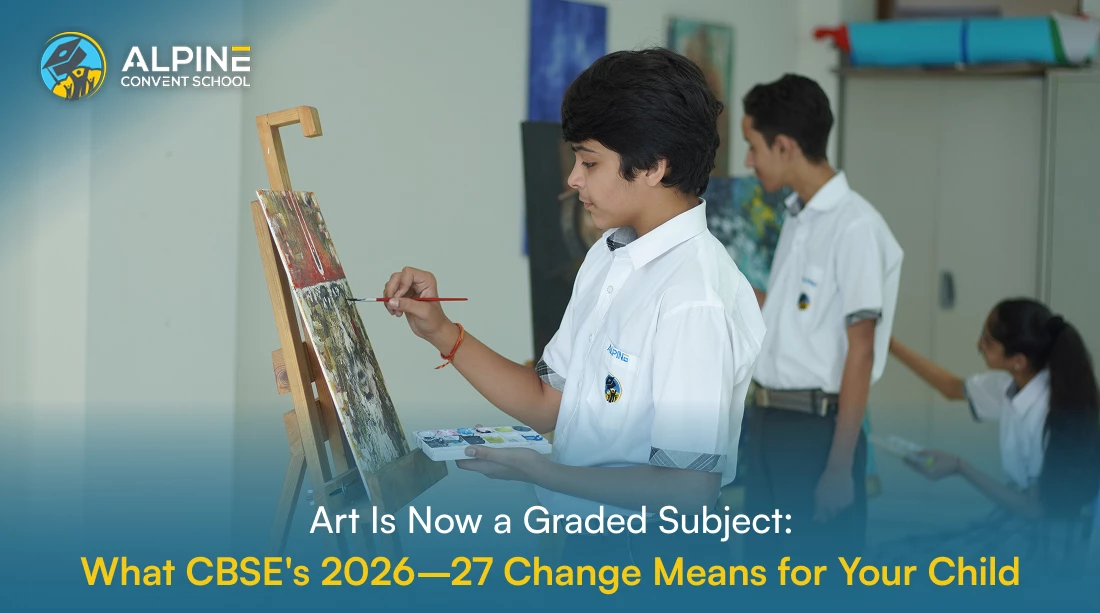
Education is changing fast across India. For a long time, drawing and painting were treated as pastime activities. Children spent an hour a week in the art room to relax. That old model is now ending. The Central Board of Secondary Education has announced a major update for the 2026–27 academic year. Art education is moving from an extra activity to a core graded subject. This means art marks will directly impact overall academic assessment. Parents researching the best CBSE school in Gurgaon need to understand this reform early, as it shifts the focus from simple book learning to complete creative development for every child.
The board is aligning its curriculum with the National Education Policy. The target is clear. Learning must become joy-filled, interactive, and deeply practical.
Why is CBSE making art a core graded subject now?
Many parents ask this question when they first hear about the change. The answer lies in how young minds process information. Research shows that visual and performing arts help students grasp hard concepts much faster.
Key features of the 2026–27 grading rule include:
Leading CBSE schools in Gurgaon are already updating their learning spaces for this shift. They are building creative studios that connect design directly with modern technology.
Art is not just about making neat drawings. It actively builds strong neural pathways in growing minds.
According to research by the Arts Education Partnership (artsedsearch.org), students involved in art education are four times more likely to earn academic awards. The study shows that artistic training strengthens problem-solving capacity across all subjects.
A separate study by the Johns Hopkins University Neuroeducation Initiative (neuroeducation.johnshopkins.edu) found that arts training improves long-term memory. Visual arts practice increases focus and helps children retain factual data better.
Sir Ken Robinson, a world leader in educational reform, once noted during a global learning summit: "Art education is not a luxury. It is a fundamental key to unlocking human intelligence and adaptability in a changing world."
This vision shows why the best CBSE school in Gurgaon places deep value on artistic practice. Top institutions like Alpine Convent School design spaces that train both sides of the brain equally.
Will your child be tested on raw talent or continuous effort?
Parents often worry if their child cannot draw well. The good news is that the new grading system does not punish lack of natural talent. Instead, it measures participation, original thought, and problem-solving skills.
The grading system uses four key tools:
The top CBSE schools in Gurgaon use clear rubric systems to ensure fair scoring for every student. Even good CBSE schools in Gurgaon are training staff to grade effort and unique ideas rather than simple neatness.
Grading art offers students a safe place to experiment. Standard exams usually have only one right answer. Art allows for many creative answers.
Key benefits of regular art assessment include:
The World Health Organization (who.int) published a comprehensive report on health and arts education. The report confirms that active art participation boosts overall mental health and social development in young learners.
How can parents support this creative journey without adding extra pressure at home?
Parents do not need to convert their homes into professional studios. Simple daily habits can build a child's confidence naturally.
Easy ways to support your child include:
Building a relaxed environment at home removes the fear of making mistakes. This allows your child to view art as an enjoyable project rather than a scary test.
Schools hold the biggest responsibility in making this policy successful. A modern school must offer expert teachers and proper creative facilities.
As the best CBSE school in Gurgaon, Alpine Convent School provides state-of-the-art creative spaces. These include art studios, music rooms, and performance spaces designed for interactive learning.
At Alpine Convent School, educators combine creative activities with core subjects every day. Math concepts become geometric art. Science lessons transform into visual posters. This approach helps children prepare for the 2026–27 CBSE standards with confidence and joy.
The new CBSE policy marks a positive change for school education in India. It recognizes that creativity is just as valuable as memorization. Art is no longer an optional hobby. It is now a core tool that prepares children for future careers in design, engineering, technology, and management.
Selecting the best CBSE school in Gurgaon ensures your child gets proper guidance during this shift. When families and schools work together, art education becomes a pathway to lifelong success and self-confidence.
No. The 2026–27 CBSE evaluation framework focuses on process, original thought, consistent effort, and reflective learning rather than raw technical mastery. Students earn marks through continuous portfolio submissions, daily logs, project research, and team participation rather than a single drawing performance.
Art integration translates abstract formulas and concepts into visual models, geometric designs, or physical representations. Educational research confirms that engaging multiple sensory pathways strengthens long-term memory, improves critical thinking, and raises overall conceptual clarity across core academic subjects.
Assessment in art education relies primarily on internal evaluation rather than traditional paper-and-pencil tests. Teachers evaluate students using process portfolios, integrated classroom projects, practical group work, and self-reflection journals collected throughout the academic year.
Alpine Convent School integrates creative studios, music labs, and performance spaces into its daily academic workflow. As a best CBSE school in Gurgaon, the institution trains faculty to interweave visual and performing arts into science, language, and social studies lessons to ensure students excel naturally under the updated guidelines.
Focus on encouraging creative problem-solving and curiosity rather than purchasing specialized tools. Provide basic materials like paper, pencils, clay, or recycled household goods, and engage your child in open-ended conversations about their project ideas, design choices, and school journals.
09 September, 2026

08 August, 2026