16 October, 2026
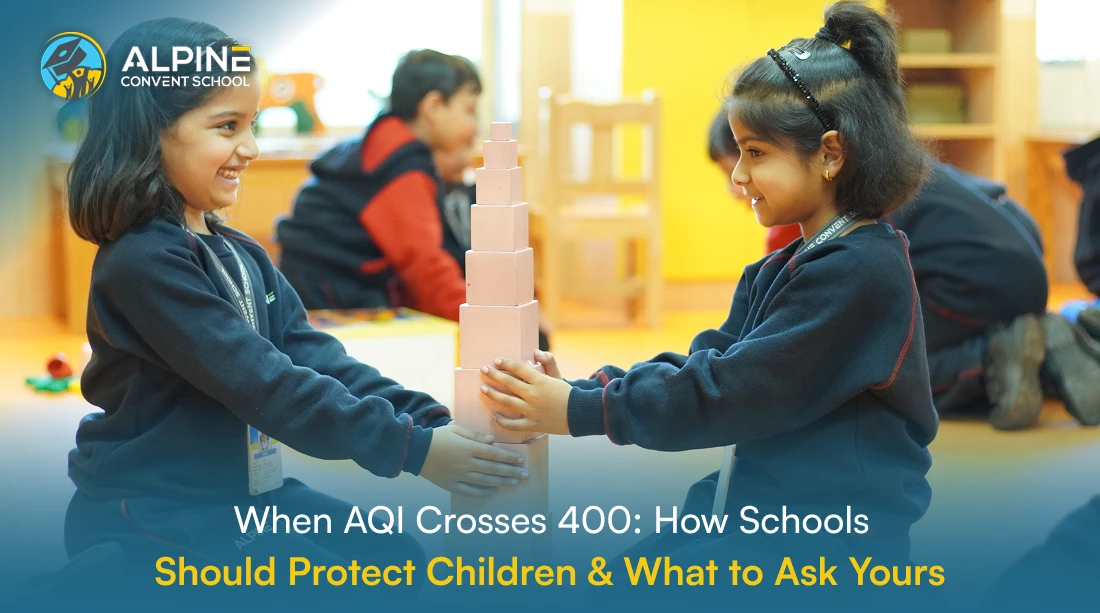
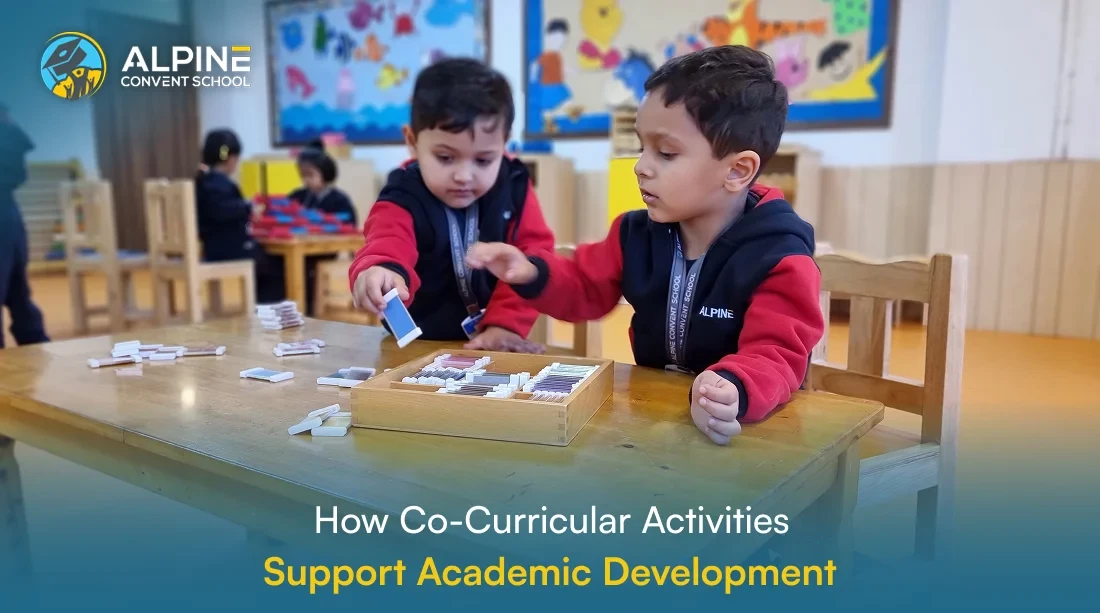
A three-year-old carefully pouring water from one small jug into another may look like she is just playing. She is actually training the concentration, hand control, and patience she will need later to hold a pencil and follow a lesson. That is the simplest answer to how co-curricular activities support academic development: they build the skills that classroom learning depends on.
Many parents comparing Montessori schools in Gurgaon still treat music, sports, art and drama as "extras" that compete with study time. The evidence and everyday classroom experience point the other way. This guide explains how these activities feed academic growth, what to look for in a school, and how to judge whether a school balances both well.
Co-curricular activities run alongside the academic syllabus and support it. Common examples include:
India's National Education Policy 2020 supports this view. It calls for no hard separation between curricular and extracurricular activities, treating them as parts of one learning experience rather than separate tracks.
The strongest research so far covers physical activity. A CDC review looked at how school-based physical activity relates to academic performance:
One honest caveat: these are associations, not proof that sport alone raises marks. A more recent review also notes that findings on school-based physical activity and academic achievement remain inconsistent. Still, across studies, active children rarely do worse academically, and many do better.
1. Better focus and self-control: Sports teach children to wait their turn, follow rules, and stay with a task. Those same habits show up when a child sits through a maths lesson or finishes a worksheet without giving up.
2. Stronger language and communication: Drama, storytelling and debate push children to listen, speak clearly and organise their thoughts. A child who has practised a role on stage often finds it easier to answer in class or present a project.
3. Hands-on understanding of concepts: Building with blocks, sorting shapes or keeping rhythm in music give children a physical feel for size, pattern and sequence. These are useful foundations for early maths, though how much they help varies from child to child.
4. Confidence to try and fail: Art and innovation projects rarely have one right answer. Children learn that mistakes are part of the process, which makes them more willing to attempt difficult academic problems.
5. Teamwork and responsibility: Group performances and team games show children how to share roles and depend on each other. Collaborative skills carry over into group projects and classroom discussions.
Montessori education blurs the line between "academic" and "activity" from the start. That is one reason parents looking for a Montessori school in Gurugram often find it suits children who learn by doing.
At Alpine Convent School, the Montessori programme covers ages 2 to 6. It includes five learning areas: real life, sensory, mathematics, language and cultural studies. Its Practical Life activities are designed to develop independence, concentration and fine motor skills, with children practising basic movements such as pouring, folding and carrying. Its General Awareness area also brings in music and art alongside geography, science and history.
Beyond the early years, the school's website lists extracurricular activities such as yoga, drama, swimming and aerobics, along with dedicated sections for arts, music, sports and innovation.
Many schools in Gurgaon list long menus of activities. What matters is how those activities connect to learning. On a campus visit, ask:
Co-curricular activities are not a break from learning. When planned well, they build the focus, language, confidence, and teamwork that help children do better in class.
The clearest way to judge any school is to see it for yourself. If you are shortlisting Montessori options for your child, you can schedule a campus visit at Alpine Convent School, explore the Montessori programme, or apply online. For admission queries, call +91 9999 700 821 or email enquiry@alpineconventschool.com. Campuses are located in Sector 10, Sector 38, Sector 56, Sector 67 and Sushant Lok-1 (Sector 28), Gurugram.
Co-curricular activities help children develop concentration, communication, problem-solving, and teamwork skills that support classroom learning. At Alpine Convent School, children can explore activities alongside academics, helping them discover interests and build confidence. Visit the campus to understand the learning approach.
Look for age-appropriate activities such as art, music, sports, drama, yoga, and innovation. A balanced programme should encourage participation, creativity and physical development alongside academics. Explore Alpine Convent School’s activities and learning environment to find suitable opportunities for your child.
Yes, co-curricular activities complement Montessori learning by encouraging independence, sensory exploration, creativity, and practical skills. Alpine Convent School’s Montessori programme includes Practical Life activities, mathematics, language, sensory learning, and cultural studies. Schedule a campus visit to see how these areas support early development.
Choose a school that integrates activities into children's learning rather than treating them as optional extras. Observe classroom sessions, ask about age-appropriate programmes, and understand how teachers track progress. Visit Alpine Convent School to explore its Montessori programme and wider extracurricular opportunities.
You can arrange a campus visit to explore Alpine Convent School’s learning environment, Montessori programme and extracurricular opportunities. Speak with the admissions team about your child's age, interests, and educational needs. Schedule a campus visit or call +91 9999 700 821 for assistance.
17 October, 2026
15 October, 2026

14 October, 2026