25 September, 2026
Ask any Class 9 student what a skill subject is, and you will often hear the same answer. "It's the easy one." That idea is wrong, and it is costing students a real chance to build career skills early. These subjects offer practical learning, career exposure, and useful skills that can support a student's academic journey beyond school.
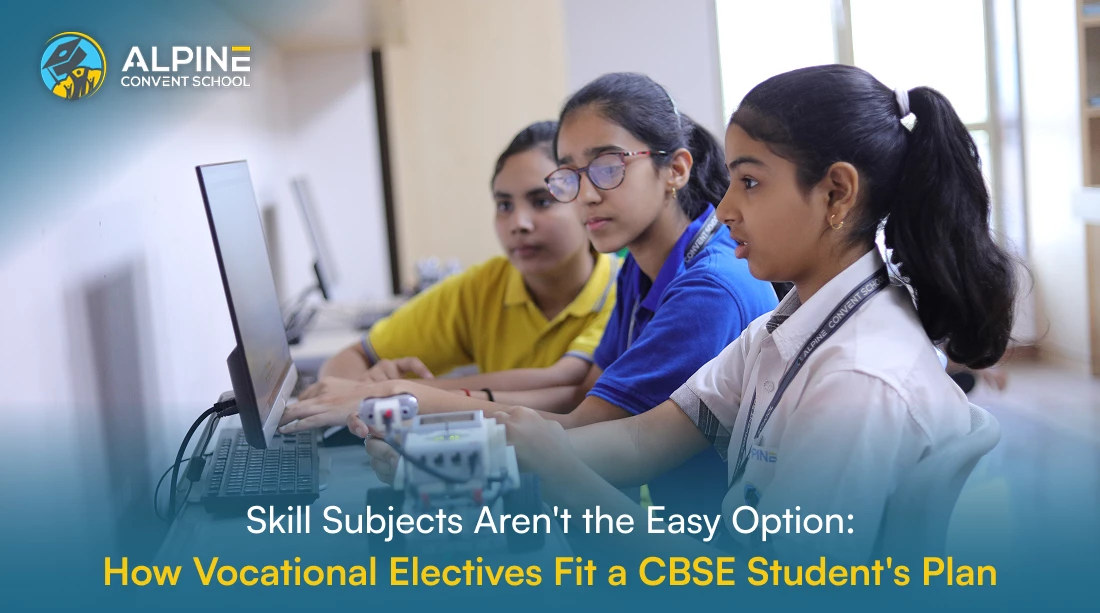
Skill subjects are not filler periods. They are structured, graded subjects with their own theory and practical exams. A student at a good CBSE school in gurgaon studies these with the same seriousness as maths or science.
CBSE currently offers 22 skill subjects for Classes 9 and 10, and 43 for Classes 11 and 12, based on a January 2025 circular from the board. These range from Information Technology and Artificial Intelligence to Financial Markets, Food Production, and Multimedia.
This belief is common, but it does not match how CBSE has built the system. A skill subject is treated as a full sixth subject, with its own weightage in the final result.
In fact, CBSE now allows a passed skill subject to replace a failed core subject like Maths, Science, or Social Science when the final result is calculated. This shows the board sees skill subjects as equal in value, not a backup plan for weak students.
The numbers tell a clear story. In the 2024-25 session, 17,13,213 Class 10 students across 23,752 schools were enrolled in skill subjects, along with 2,56,417 Class 12 students across 8,570 schools.
That is a large and growing group. It shows Indian parents and students are no longer treating these subjects as optional extras.
CBSE has made real changes for the 2025-26 session, and students need to know them.
Many parents ask this question directly. Does a skill subject actually help beyond school?
It does, in a practical way. A student who studies Artificial Intelligence or Financial Markets in Class 10 walks into Class 11 stream choices, and later college applications, with real hands-on exposure, not just a textbook idea of the field.
This change is not random. It comes from the National Education Policy 2020, which treats vocational learning as a core part of schooling, not a lesser path.
Dr. Timir Tripathi, a regional director at IGNOU, has pointed out that only around 6 percent of Indian students currently get access to vocational education, compared to over 95 percent in South Korea. NEP 2020 aims to close this gap sharply in the coming years.
This context matters for any cbse schools in gurgaon are shortlisting, since it shows why skill subjects now carry real weight in a student's overall academic record.
Not every school runs its skill programme the same way. Some treat it as a box to tick, while others build it into the timetable with real teaching time and practical exposure.
Here is what parents should check:
At Alpine Convent School, skill subjects are treated with the same academic seriousness as core subjects, with proper classroom time and practical sessions built into the schedule across the school year.
Choosing between different options can feel confusing. Many families compare the best CBSE schools in gurugram shortlist before making a final decision, and skill education is now a real factor in that comparison.
A few points worth checking directly with any school:
Parents searching for a top CBSE school in gurugram should treat this as seriously as they treat board exam results, since skill choices made in Class 9 can shape options much later.
Alpine Convent School follows the CBSE skill education framework closely across its Gurugram campuses, with structured practical sessions and subject guidance for students choosing their electives. This keeps the focus on real learning, not just an easy mark on the report card.
CBSE skill subjects are not necessarily difficult, but they require regular learning and practical participation. Students may study both theory and practical components. The difficulty also depends on the subject chosen. Artificial Intelligence, Information Technology, Financial Markets, and other electives can require different types of skills and preparation.
CBSE offers several skill subjects for Classes 9 and 10, including Information Technology, Artificial Intelligence, Retail, Introduction to Financial Markets, and other vocational options. The exact subjects available to a student depend on the school's offerings. Parents should check the school's current subject list before making a choice.
Students should choose a skill subject based on their interests, strengths, and possible career preferences. A student interested in technology may consider Artificial Intelligence or Information Technology. Someone interested in business may prefer Financial Markets. Schools can also help students understand the subject content before making their final choice.
Yes, many CBSE skill subjects include practical activities, projects, demonstrations, or other hands-on assessments along with theory. The exact assessment pattern depends on the subject and applicable CBSE guidelines. Students should therefore understand both the theoretical syllabus and practical requirements before selecting an elective.
Skill subjects can give students early exposure to different fields before they select a stream in senior secondary classes. Studying technology, finance, design, or another vocational area can help students understand their interests better. This practical exposure can support more informed decisions about future subjects, courses, and career paths.

15 September, 2026
09 September, 2026