19 June, 2026
The world is changing very fast. Technology is growing every single day, and the job market is completely different now. In the past, going to school meant memorizing lessons, passing exams, and getting a degree. Today, that old method is not enough to help a child succeed. Parents often wonder how they can prepare their young ones for a future that no one can fully predict. Education must look forward and teach skills that remain useful for a long time.
Many people ask what a modern classroom should look like to help children grow. Do high-tech gadgets alone make a student ready for tomorrow? Or is it about changing the complete way we think about learning? To find the true answers, we must look at how forward-thinking institutions are reshaping their daily classrooms this year.
Being future-ready means learning how to adapt to new situations easily. It is not just about scoring high marks on paper. It means a child can think deeply, solve complex problems, and use technology in a smart way.
According to the National Education Policy, which outlines major reforms for Indian boards, schools must shift away from simple rote learning. The official Central Board of Secondary Education guidelines for the 2026 academic cycle state that around 50% of board exam questions are now competency-based. This means exams now test how well a student can apply knowledge to real-life situations.
Education experts believe that true preparation begins when children learn how to learn. Sachindra Pratap Singh, a prominent education official, noted that traditional models must evolve because degrees alone cannot guarantee success, and students need early exposure to practical skills and problem-solving.
The educational landscape in Delhi NCR has transformed wonderfully over the last few years. Today, CBSE schools in Gurugram are leading this massive shift by adopting modern teaching methods. These institutions are no longer just places with four walls and a blackboard. They have become active hubs for innovation and deep conceptual understanding.
By focusing on these practical methods, CBSE schools in Gurugram ensure that students enjoy the process of learning. This makes knowledge stick with them for life.
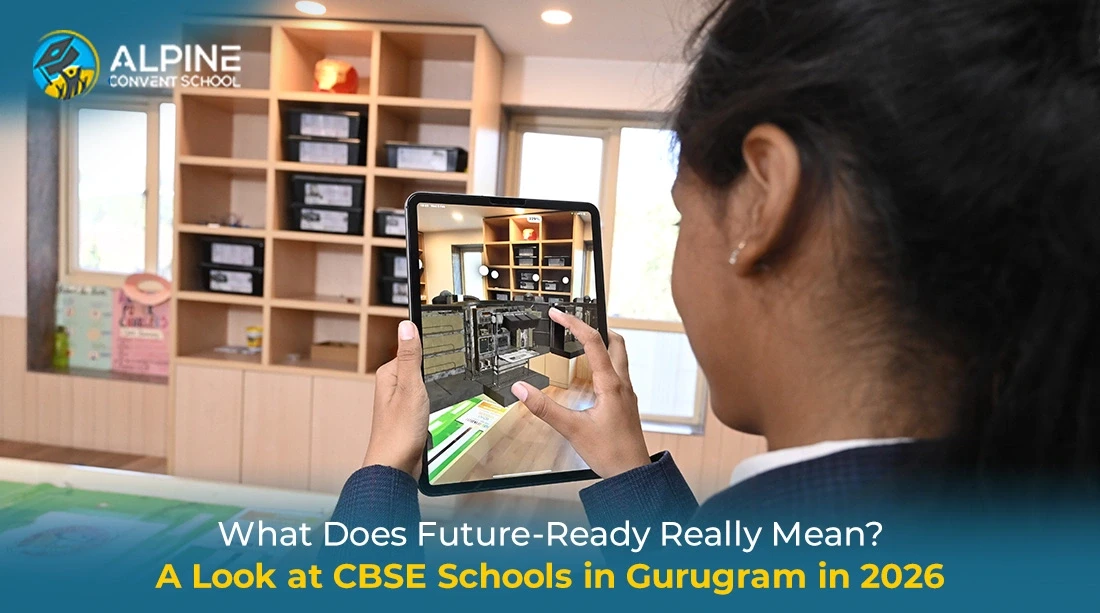
Technology is a massive part of our daily lives in 2026. Because of this, modern schools have updated their subjects. The new CBSE framework has introduced computational thinking and foundational Artificial Intelligence modules into the curriculum for young classes.
When looking for the best CBSE schools in Gurugram, parents actively check if the campus has modern computer labs and tech-driven tools. This digital exposure helps students feel comfortable with advanced technology from an early age.
A bright future requires more than just digital knowledge. Emotional intelligence and life skills are equally important for young minds. The best CBSE school in Gurugram will always give equal importance to mental well-being, sports, and arts.
Fostering these emotional traits creates balanced individuals who can easily face real-world challenges without feeling overwhelmed.
True learning happens when students experience a concept firsthand. Many top CBSE schools in Gurgaon are replacing long lectures with experiential learning activities. For example, a math lesson about shapes might involve measuring real objects around the school campus.
This wonderful approach makes education highly interactive. It helps students understand the actual purpose behind every lesson they study.
Choosing the right institution is the most vital decision for any caring parent. Alpine Convent School focuses heavily on creating a nurturing environment where future-ready skills grow naturally. The campus combines traditional values with modern global standards beautifully.
At Alpine Convent School, the main focus is always on the holistic development of every single child. The dedicated teachers ensure that students receive personal attention and learn at their own comfortable pace.
Through well-planned international infrastructure and a skill-focused curriculum, Alpine Convent School prepares its students to become confident global citizens. The school ensures that every child passes out with a strong mind, great values, and practical skills.
Being future-ready is a continuous journey of growth, curiosity, and adaptation. It is about building a strong foundation that helps a child stand tall in a rapidly changing world. By choosing the right educational partner among the finest CBSE schools in Gurugram, parents can ensure a bright, secure, and successful tomorrow for their precious children.
Instead of asking students to directly repeat a definition memorized from a textbook, competency-based questions present a real-world scenario. Students must use their knowledge to solve the problem. For example, instead of just defining a math formula, a question might ask a student to use that formula to calculate the materials needed to build a running track. This tests actual understanding rather than just memory.
Modern schools introduce basic logical thinking as early as primary school (Classes 1 to 3). At this young age, children do not type complex code lines. Instead, they use fun, visual puzzle games and blocks to learn how sequences and logic work. This builds the foundational mindset needed for advanced computing later on.
Not at all. Future-ready teaching actually strengthens traditional academics. Instead of replacing core subjects like math, science, and languages, it changes how they are taught. Students still learn the complete CBSE syllabus, but they do so through hands-on experiments, projects, and discussions that make the concepts easier to understand and remember.
When visiting a school, look at the classrooms and student work. A truly experiential school will have active spaces like science labs, design rooms, and math labs filled with models. Ask the educators how a typical lesson is conducted. If the answer involves projects, group activities, and field trips rather than just reading from a whiteboard, the school is genuinely practicing experiential learning.
Technology and workplaces change rapidly, which can bring new kinds of stress. A student who only knows how to score well on tests might struggle when a real-world project fails. Teaching emotional resilience through sports, arts, and teamwork helps children learn how to handle mistakes, adapt to sudden changes, and keep trying without losing confidence.

15 September, 2026
09 September, 2026